Mine of Information - Beginner’s Guide to Installing from Source
False Sharing
没有正确性问题,归根结底还是因为访问了不同的内存地址吧
int sum1;
int sum2;

void thread1(int v[], int v_count) {
    sum1 = 0;
    for (int i = 0; i < v_count; i++)
        sum1 += v[i];
}

void thread2(int v[], int v_count) {
    sum2 = 0;
    for (int i = 0; i < v_count; i++)
        sum2 += v[i];
}
1.首先, thread1 将 sum1 读入其缓存。由于该行不存在于其他任何缓存中, thread1 处于独占状态:
2.thread2 现在读取 sum2 。由于 thread1 的缓存行已经在独占状态,这会导致 thread1 的缓存行降级,并且缓存行现在在两个缓存中都处于共享状态:
3.thread1 现在将其更新后的总和写入 sum1 。由于它只在共享状态下拥有该行,因此必须升级该行并在 thread2 的缓存中无效该行:
4.thread2 现在将其更新后的总和写入到 sum2 中。由于 thread1 已在其缓存中失效了该缓存行,因此发生了一致性缺失,并且必须在 thread1 的缓存中失效该行,从而迫使 thread1 执行一致性写回:
5.下一次循环迭代现在开始, thread1 再次读取 sum1 。由于 thread2 刚刚在 thread1 的缓存中失效了缓存行,它会遇到一致性缺失。它还必须在 thread2 的缓存中降级该行,迫使 thread2 执行一致性写回操作:
6.thread2 最终读取了 sum2 。由于它有共享状态的缓存行,因此可以无需一致性活动就进行读取,我们又回到了步骤 2 结束时的情况
3到6昂贵的升级、一致性缺失和一致性写回
Execution vs interpretation
deepseek生成
传统硬件执行:
经典的CPU通过硬连线路(Hardwired Logic)直接实现取指-解码-执行周期。每条指令的每个步骤(如加法、跳转)都由专用电路处理。这种方式高效但灵活性低,修改指令集需重新设计硬件。
通过微码解释器,硬件专注于高效执行μops,而非直接处理复杂指令。这使得设计更模块化,例如现代CPU可复用相同的ALU(算术逻辑单元)处理多种指令。
软件解释器:
通过软件(如微码,即Microcode)实现指令的解释。复杂指令被分解为更小的微操作(μops),这些μops由底层硬件执行。微码存储在CPU内部的固件中,充当“解释器”,将复杂指令翻译为硬件可直接执行的原子操作。
示例:
x86处理器的复杂指令(如字符串操作)会被微码分解为多个μops(如加载、计算、存储),硬件仅需实现这些基础操作。
向后兼容性:
微码允许通过更新固件(而非修改硬件)支持旧指令集。例如,新x86 CPU通过微码升级兼容几十年前的软件,无需重新设计电路。
-
历史背景(CISC架构):
20世纪70-80年代,CISC(复杂指令集计算机,如x86)采用微码实现庞大指令集。指令集包含高度抽象的指令(如单条指令完成复杂操作),通过微码解释适配硬件,但牺牲了一定的效率。后来RISC(精简指令集)通过简化指令集和硬连线逻辑提高了性能,但现代CPU(如Intel/AMD)融合了两者:硬件直接执行常见指令,复杂指令仍依赖微码。 -
执行(硬连线):高效但缺乏灵活性,适合固定指令集。
-
解释(微码):灵活且简化硬件设计,支持复杂指令集和向后兼容。
cache可能会导致写放大
cpu是byte-addressable,而cacheline granularity更大
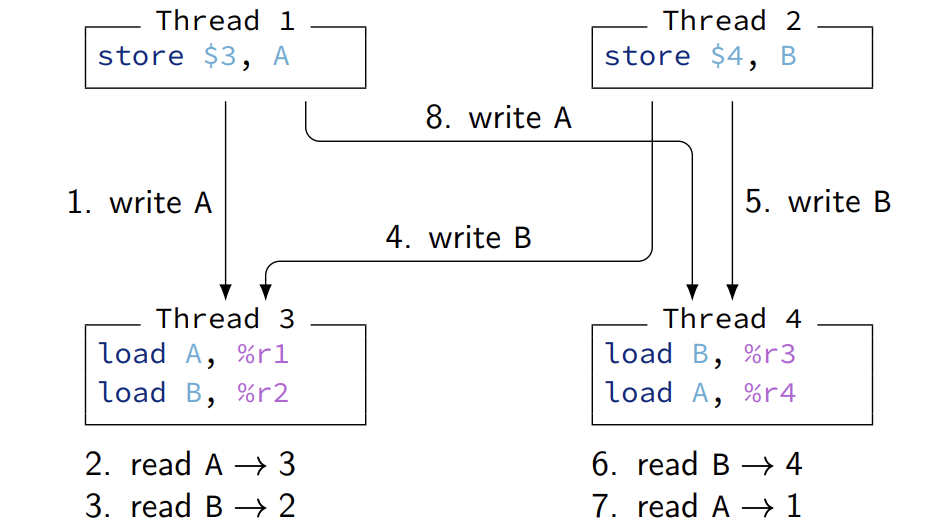
weak memory order
在strong中 8发生在5之后是不被允许的,观察到写的顺序得一致
锁需要维护状态16-40bytes
获取锁需要系统调用,耗时
coarse-grained locking
高争用下degrade
获取锁的延迟明显增加,即使是共享锁
乐观锁
试图优化读为大多数的情况
由于上述原因,共享锁没有用
• Associate a version with the shared resource
• Writers still have to acquire an exclusive lock of some sort
• This ensures that only one writer at a time has access to the resource
• At the end of its critical section, a writer atomically increases the version
• Readers only have to read the version
• At the begin of its critical section, a reader atomically reads the current version
• At the end of its critical section, a reader validates that the version did not change
• Otherwise, a concurrent write occurred and the critical section is restarted
writer(optLock) {
	lockExclusive(optLock.mutex) // begin critical section
	// modify the shared resource
	storeAtomic(optLock.version, optLock.version + 1)
	unlockExclusive(optLock.mutex) // end critical section
}
reader(optLock) {
	while(true) { current = loadAtomic(optLock.version); // begin critical section
	// read the shared resource
	if (current == loadAtomic(optLock.version)) // validate
	return; // end critical section
	}
}
读者只需要两个原子load,比共享锁便宜
但是注意,共享资源在我们访问时可能被修改,不能做出consistent state的假设
更复杂的读操作需要更多中间检查
non-blocking
不依赖锁的,使用原子操作
一般是lock-free的同义词,表示至少能有一个线程能make progress
lost update和A-B-A问题
CAS没有公平性,不保证某个线程最终能获得锁